


The impact of monopolies on inequality and can we resolve it?
- Nikhil Chidipothu

- Aug 24, 2021
- 4 min read
Arguably the society of today can be considered to be significantly better than the society 1000 years ago; with improved healthcare, easier access to trade goods and services and has seen greater economic progress yet despite this one factor has often been neglected throughout the years: inequality - in America the richest 0.1% are as wealthy as the poorest 90% of the population illustrating the sheer magnitude of inequality. Although several factors can explain the increase in inequality over the years there has been one hidden culprit responsible for it – monopolies.
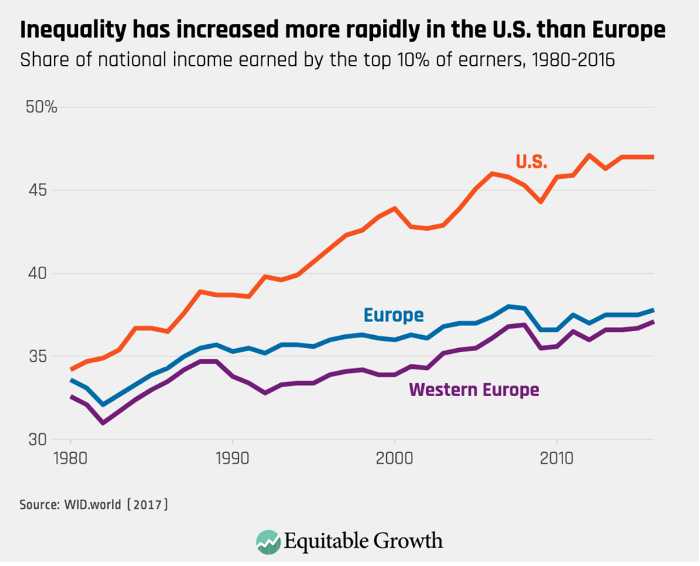
Illustrated below is a graph depicting the increase in inequality from the 1980s:
As we can see the top 10% of earners own a greater portion of national income, on average each year indicating the extent to which inequality is deepening as we continue to let it take its toll on society.
Source taken from https://equitablegrowth.org/eight-graphs-that-tell-the-story-of-u-s-economic-inequality/
But what actually is a monopoly? A monopoly is when a company and its product offerings dominate the industry: in the UK a monopoly is classified a monopoly if it has a market share greater than 25%. In actuality, all companies, driven by the profit motive aim to achieve monopolistic power, in order to maximise revenue. In a monopoly, a single supplier controls the entire supply of a product which leads to a rigid demand curve. That is, demand for the product remains relatively stable no matter how high (or low) its price goes.
So how do monopolies actually lead to inequality? Well, monopolistic power evidently leads to an increase in inequality as suppliers can charge excessive prices for goods; the impact this on the upper classes is minimal as they can afford to pay the extra prices. However, with the lower classes an increase in prices is much harder to pay for as they have a lower disposable income so end up paying a greater portion of their income. This state of inequality is further exacerbated if monopolisation causes an increase in price of basic needs such as water or food; there would therefore be a smaller part of the population with access to basic necessities – resulting in decreased life expectancy and increased pressure on the healthcare system which could actually lead to a nation progressing backwards.
Another means of deepening inequality could be the fact that monopolies have the power to exploit their staff since there is less competition for the labour of workers. If there is less competition in a market, workers will tend to work for the monopoly regardless of the wage as there aren’t many jobs elsewhere. Consequently, this leads to many workers that have reduced wages because firms try to reduce costs of production so a smaller disposable income and can spend less on their required goods and services simply deepening the divide. In 2020, in the UK 139 companies have been fined for not paying their workers sufficiently and this is just an indication of the extent to which the money-driven ideologies of a free market system could indeed by flawed and so the question arises as to whether such high levels of competition are healthy.
As the problem of inequality continues to become a more menacing threat to society, the problem remains as to what the government can do to resolve this issue because monopolies themselves are not illegal however, certain behaviour can be considered abusive and not permitted.
So one potential solution to reduce the power of monopolies is to simply make tighter regulations relating to monopolies or simply make them illegal. However, making them illegal altogether would be near impossible or counter intuitive as it would reduce competition since there is a reduced incentive to gain revenue if firms know that the government could very well just disband them. Therefore this leaves the alternative to implement measures that increase benefits to society and to regulate monopolistic power.
There are plethora of ways a government can do so – some of them include: price capping i.e. setting a price ceiling/floor and nationalisation and implementation of anti-trust laws. To begin with, setting a price ceiling or a floor will ensure that the price of a good doesn’t increase above a certain price – this therefore prevents the cost of a good or service from going too high ensuring ease of accessibility to all citizens alike thus promoting equality. Furthermore another method to ensure equality is through nationalisation of industries; if a particular industry has a monopoly then nationalisation of the industry means that the government buys over the industry and so there is no competition in that industry as it’s owned by the state – therefore it then becomes the responsibility of the government to provide goods and services of that particular industry for society as a whole. Finally implementation of anti-trust laws prevent business practices that either create or maintain a monopoly e.g. in the USA there’s an act called the Sherman Antitrust Act that prohibits practices whose main objective is to create or maintain a monopoly.
To conclude, the impact monopolies have on inequality is detrimental and although it goes unnoticed, simply ignoring the problem will only make it worse as monopolies can simply continue abusing their power so although we can’t fully eradicate the problem as that will simply create an uncompetitive environment we should instead simply tighten regulations or invent new anti-trust laws for example that could restrict monopolistic power in order to mitigate the impact on lower classes.


Comments