


How governments can tackle global inequality
- aarushupadhyay16
- Mar 20, 2021
- 3 min read
The world is diseased with inequality. According to an OECD, the Organisation for Economic Co-operation and Development, study released in December 2014, the difference between rich and poor in most OECD countries has reached its highest level in 30 years. The top 1% of taxpayers, whose wages have risen away from the average, are driving the overall rise in income inequality.
Reduced inequality by tax and transfer policies, according to the OECD, does not affect development if the policies are well-designed and enforced. They suggest that redistribution initiatives should emphasise families with children and adolescents, as well as increases in human capital investment through skill growth and learning.

Figure 1. Graph to show tax revenues across the world by ourworldindata.org.
High tax rates affect low-income households, or households where the main earner is working off minimum wage. Governments can use the tax and profit mechanism to encourage diversity and reduce income and wealth inequality. This entails a liberal tax and benefit scheme whereby high-income earners contribute proportionately more tax and welfare benefits are allocated with those with lower incomes. In the United Kingdom, income tax is relatively fair and contributes in redistributing wealth when compared to countries such as Sweden
This is because due to our tax brackets and regulations:
· The tax-free ‘personal' allowance was £10,000 in 2014.
· In addition, wage earners are subject to the 'basic rate,' which is 20%.
· Those with "higher wages" pay more in tax of 40% on a percentage of their income.
· Tax rates are higher for those with an income above £150,000.
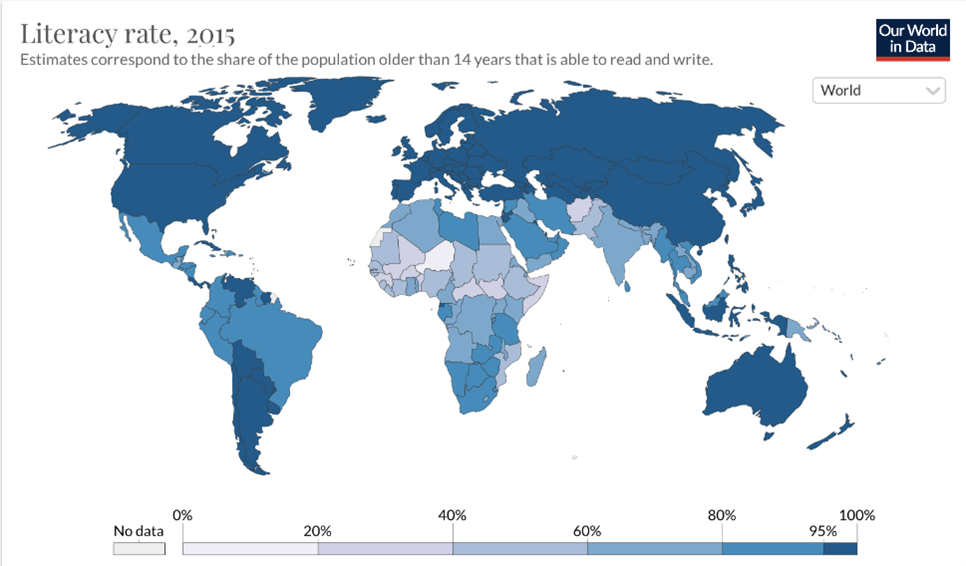
Figure 2 shows literacy rates around the world, given by ourworldindata.org.
Apart from taxation rates, another focus should be on literacy rates. The graph above compares and shows the literacy rate in 2015 to the Gini coefficients of different countries around the world. While correlation doesn’t mean causation, we can see that countries with higher literacy rates have lower income inequality. Improving education would seem to be a vital aspect in working for a more inclusive society. The main issue is thinking of ideas on how to achieve the said objective. Governments will improve literacy rates and academic ability by promoting access to education, such as making education more affordable and freer for all, and by increasing capital investment in education. By providing children a platform to make their own future, allows them to have high paying jobs and overtime combating financial and academic inequality.
Another main cause of inequality in today’s world is due to unemployment. Fiscal policy can help to reduce unemployment by rising aggregate demand and the pace of economic growth. The government would need to follow expansionary fiscal policy, which means lower taxes and higher government spending. Lower taxes raise disposable income (e.g., VAT was reduced to 15% in 2008) and therefore help to increase consumption, resulting in higher aggregate demand (AD).
Real GDP would grow in response to an increase in AD (if there is spare capacity in the economy.) As industries generate more, there would be more demand for jobs, resulting in lower unemployment where it’s cause was a lack of demand. Furthermore, with stronger aggregate demand and solid economic growth, less businesses would collapse, resulting in less employment losses. We can see the effect of increased AD on the economy in the graph below. There is an increase on Real GDP due to price levels increasing due to a higher demand, and having a higher net profit revenue.

Figure 3 Diagram to show effect of increased AD.
Governments can also help combat supply side unemployment. My proposition aims to provide long-term unemployed people with new skills that will help them find employment in emerging sectors, such as retraining people who were previously employed in manual labour such as builders and dinner ladies in basic I.T. skills that will help them find work in the service sector. However, even though college and training opportunities are open, unemployed individuals can be unable or unable to learn new skills due to them either being inept to learning new skills either due to them being illiterate or having a disability of any sort. In this case we will have to work around that with rehabilitation. In any case, this solution is aimed to be long term, which means there won’t be any immediate results which is the only disadvantage.
To summarise, I think that inequality is a serious problem of which governments around the world can do everything possible to help tackle it. Improving the quality and accessibility of education so children can make their own path, using their own hard work they can reap the benefits, and over time tackle inequality around the world


Comments